Formulas for Settlement Calculations.
The following formulas were developed for computing settlements for square footings.
For normally consolidated soils and gravels
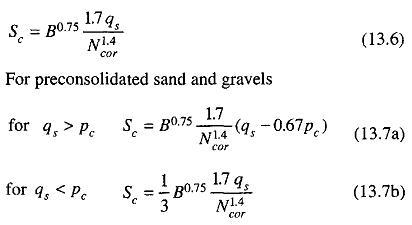
If the footing is established at a depth below the ground surface, the removal of the soil above the base level makes the sand below the base preconsolidated by excavation. Recompression is assumed for bearing pressures up to preconstruction effective vertical stress q'o at the base of the foundation. Thus, for sands normally consolidated with respect to the original ground surface and for values of qs greater than q'o, we have,

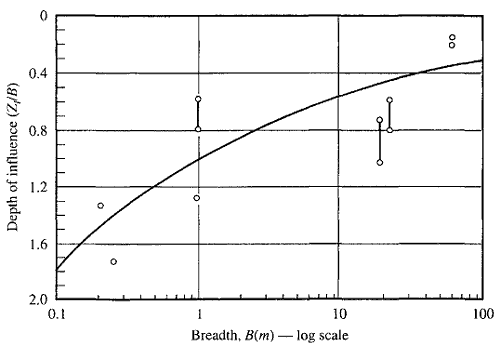
Figure 13.4 Thickness of granular soil beneath foundation contributing to
settlement, interpreted from settlement profiles (after Burland and Burbidge 1985)
settlement, interpreted from settlement profiles (after Burland and Burbidge 1985)
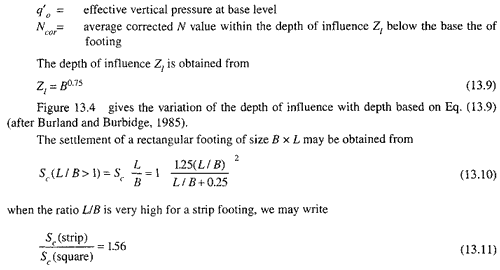
Chart for Estimating Allowable Soil Pressure
Fig. 13.5 gives a chart for estimating allowable bearing pressure qs (on settlement consideration)
corresponding to a settlement of 16 mm for different values of TV (corrected). From Eq. (13.6), an
expression for q may be written as (for normally consolidated sand)
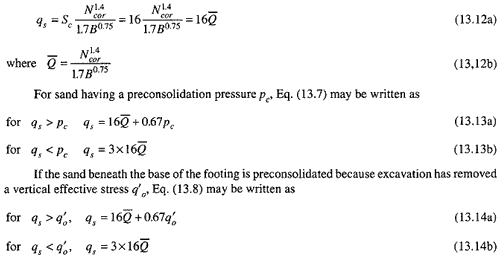

Figure 13.5 Chart for estimating allowable soil pressure for footing on sand on the
basis of results of standard penetration test. (Terzaghi, et al., 1996)
basis of results of standard penetration test. (Terzaghi, et al., 1996)
The chart m Fig. 13.5 gives the relationships between B and Q. The value of qs may be obtained from Q for any given width B. The Q to be used must conform to Eqs (13.12), (13.13) and (13.14).
The chart is constructed for square footings of width B. For rectangular footings, the value of qs should be reduced in accordance with Eq. (13.10). The bearing pressures determined by this procedure correspond to a maximum settlement of 25 mm at the end of construction.
It may be noted here that the design chart (Fig. 13.5b) has been developed by taking the SPT values corrected for 60 percent of standard energy ratio.

No comments:
Post a Comment